ultrasound and fine needle biopsy
Ultrasound-guided fine needle aspiration for head and neck area investigation
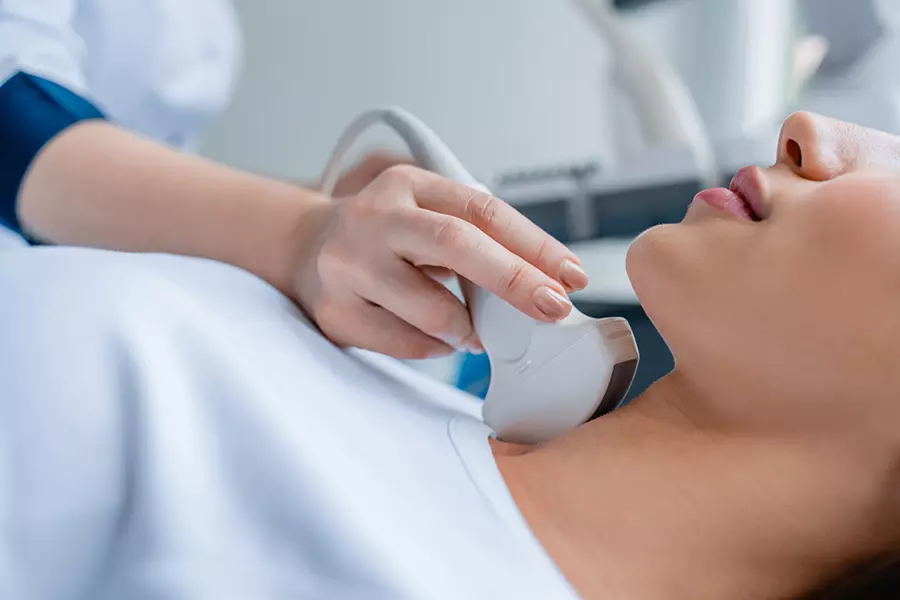
Our surgeons can perform ultrasound-guided fine-needle aspiration (US-FNA) on the same day as a consultation, saving multiple appointments, costs, travel and stress for patients.

Medically reviewed by Dr Yi Chen Zhao, FRACS, ENT Surgeon
Last reviewed 20 August 2026.
Ultrasound guided FNA
Ultrasound guided fine needle aspiration is a minimally invasive procedure performed on the head and neck area to investigate thyroid nodules, lymph nodes, salivary gland masses or other head and neck lumps. In this procedure, cells are removed from the area of investigation and sent for testing.
Contact Us
467 Upper Heidelberg Road,
Heidelberg Heights, VIC 3081
03 9998 7459
What is involved in ultrasound guided fine needle aspiration?
A fine needle aspiration is a short procedure taking approximately 10 minutes. During the procedure an ultrasound machine is used to locate the area to be sampled while a very thin needle is inserted. The needle is then moved gently in the area under ultrasound imaging to take a sample of cells before being removed. The procedure is followed by a short recovery period before going home.
There is no fasting or other preparation required. A local anesthetic may be used to numb the area prior to the procedure.
Surgeon Performed Ultrasound
Ultrasound is a highly operator-dependent investigation. A surgeon-performed ultrasound involves the specialist surgeon performing a dedicated ultrasound on the patient in the office or consultation room.
This allows the treating specialist to perform a surgical-oriented scan, looking for features that are important from the surgical point of view (and sometimes not addressed on conventional scans).
A surgeon-performed ultrasound permits the surgeon to clearly display scan findings to the patient in real-time, providing a description within the clinical context, so that the patient is better informed. It avoids radiation and is safe and accurate.
Conditions best suited for surgeon-performed ultrasound
Surgeon-performed ultrasound is extremely useful for the workup of patients with benign neck lumps, parotid and submandibular gland masses, head and neck cancer, thyroid nodules and parathyroid adenomas.
When combined with US-FNA, it is the most accurate imaging tool in the detection of pathological lymph node metastases in the head and neck. It is performed by otolaryngology head and neck surgeons throughout North America, Asia, Europe and Australia and has been shown to change the surgical management in a large percentage of patients.
Frequently Asked Questions
Ultrasound-guided fine needle aspiration (US-FNA) is a minimally invasive test used to investigate a lump in the head or neck, such as a thyroid nodule, an enlarged lymph node or a salivary gland mass. The surgeon uses ultrasound to see the exact spot, then passes a very thin needle in to collect a small sample of cells for the laboratory. It usually takes about ten minutes. When the surgeon performs the scan, they can show you the findings on screen as they go.
Most people find it uncomfortable rather than painful, similar to a blood test, and a local anaesthetic may be used first. There is no need to fast beforehand, and you can usually drive yourself home afterwards. The needle is very thin, so the biopsy is quick and any soreness settles soon after. Your surgeon will explain anything specific to your situation.
When the surgeon both scans and takes the sample, they can target the exact area of concern and explain what they see straight away. Ultrasound uses sound waves rather than radiation, so it is safe and can be repeated. Doing both in one visit often means faster answers and fewer separate appointments. Your surgeon will tell you when to expect the laboratory results.
Our ENT Team
All of our specialists are fellows of the Royal Australasian College of Surgeon and have undertaken additional sub-specialist training.
Our ENT specialists take a thorough, personalised approach to your care, from initial consultation through to treatment and beyond.
Surgeons consulting at ENT Specialists Group are also members of the Australian Society of Otolaryngology Head and Neck Surgery.
If you’d like to understand more about treatment and surgical options, contact us today or make an online booking.