Throat and Voice
Swallowing Difficulty(Dysphagia)

Difficulty swallowing (dysphagia) means food, drink or saliva doesn’t pass easily from your mouth to your stomach. It might feel like food is sticking in your throat, or you might cough or choke when you eat or drink.
Swallowing problems are common, particularly as we get older. Many causes are treatable. An ENT surgeon can look at your throat and voice box directly and work out where the problem is.
At ENT Specialists Group, our surgeons work with our speech pathologist and dietitian, so assessment, therapy and diet advice can happen in the same practice.
When to get help quickly
Call 000 or go to an emergency department if you:
- Suddenly can’t swallow at all, including your saliva
- Have food or an object stuck in your throat
- Have trouble breathing, or noisy breathing, with swallowing problems
See your GP soon if you have:
- Swallowing that is getting worse over weeks or months
- Weight loss you can’t explain
- A hoarse voice as well as swallowing problems
- A lump in your neck
- Pain when you swallow that doesn’t settle
- Coughing up blood
These matter more if you smoke, have smoked, or drink alcohol heavily.
Signs of a swallowing problem
- Food feeling stuck in your throat or chest
- Coughing, choking or throat clearing when you eat or drink
- A wet or gurgly voice after eating
- Food or drink coming back up, or out through your nose
- Taking a long time to finish meals, or avoiding some foods
- Drooling, or saliva pooling in your mouth
- Chest infections that keep coming back
- Losing weight without trying
Some people have the feeling of a lump in the throat without any trouble getting food down. This is called globus, and it is often linked to reflux or muscle tension. It is usually not serious, but it should be checked if it doesn’t settle.
Why swallowing problems matter
When food or drink goes into the airway instead of the food pipe, it’s called aspiration. Some people cough when this happens, but some don’t notice at all (silent aspiration). Over time this can lead to chest infections and pneumonia.
Swallowing problems can also lead to weight loss, poor nutrition and dehydration. Many people start avoiding meals with family and friends. Treatment helps with all of these.
Common causes
Throat and voice box problems
Reflux can irritate the throat and cause a lump-in-the-throat feeling or a sense that food is catching. Inflammation, infection and enlarged tonsils can also make swallowing hard or painful. Read more about reflux affecting the throat
A weak vocal cord
If a vocal cord doesn’t close properly, food or drink can slip into the airway. This causes coughing when drinking and a breathy voice. It can happen after surgery on the neck or chest, including thyroid surgery.
A pouch in the throat
A pharyngeal pouch (Zenker’s diverticulum) is a small pocket that forms at the top of the food pipe. Food can collect in it and come back up later, sometimes with bad breath or a gurgling sound in the neck.
Tight muscle at the top of the food pipe
The cricopharyngeus is a ring of muscle at the top of the oesophagus. If it doesn’t relax properly, food can feel as though it catches at the base of the throat.
Head and neck cancer and its treatment
A growth in the throat, voice box or oesophagus can make swallowing difficult or painful. Radiotherapy and surgery for head and neck cancer can also affect swallowing, sometimes for a long time afterwards. Read about neck lumps and head and neck cancer
Nerve and muscle conditions
Stroke, Parkinson’s disease, motor neurone disease, multiple sclerosis and dementia can affect the muscles used to swallow. Swallowing also changes with age.
Other causes
Some medicines cause a dry mouth or affect swallowing muscles. A narrowing (stricture) of the oesophagus, an enlarged thyroid gland and some tablets that irritate the food pipe can also cause problems. Read about thyroid conditions
Procedures
If a swallowing problem has a physical cause, such as a narrowing or a weak vocal cord, a procedure may help. Depending on what’s found, our surgeons can stretch a narrowed area of the oesophagus (oesophageal dilation), inject a weak vocal cord, treat a pharyngeal pouch, or relax a tight cricopharyngeus muscle with Botox or a small operation called a myotomy. Our surgeons perform all of these. Some are done during a microlaryngoscopy or endoscopy under general anaesthetic.
Types of dysphagia
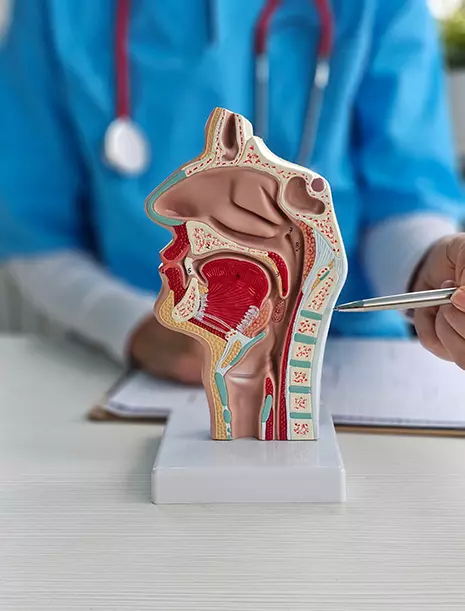
Oropharyngeal dysphagia starts in the mouth or throat. People with this type often have trouble starting a swallow, or they cough and choke as they swallow. It is the type ENT surgeons and speech pathologists most often assess.
Oesophageal dysphagia happens lower down, in the food pipe (oesophagus). It feels like food sticks in the lower throat or chest a few seconds after swallowing. This type is often assessed by a gastroenterologist, and your ENT surgeon may refer you on.
How we assess swallowing
Your appointment
Your surgeon will ask about your symptoms, how long you’ve had them and which foods or drinks are hardest. They’ll check your mouth, throat and neck.
They’ll then look at your throat and voice box with a thin, flexible camera passed through your nose (nasendoscopy). A numbing spray is used first. It takes a few minutes and you stay awake.
Videofluoroscopy (modified barium swallow)
You swallow food and drink mixed with barium while an X-ray video records your swallow. It shows the whole swallow, from the mouth to the food pipe. This procedure is typically carried out at a radiology clinic.
Tests you might need
FEES (fibreoptic endoscopic evaluation of swallowing). A speech pathologist watches you swallow small amounts of food and drink through the same thin camera. It shows how well your throat clears food and whether anything enters the airway.
This procedure is carried out at our Heidelberg practice with Sophie Bradstreet and Dr Sam Flatman.
Other tests
Depending on your symptoms, your surgeon may arrange a CT scan, an ultrasound of your neck, or a referral for a gastroscopy (a camera test of the food pipe and
stomach).
Treatment
Treatment depends on the cause. Many people need more than one approach.
Swallowing therapy
A speech pathologist teaches you exercises to strengthen the swallowing muscles, and techniques such as changing your head position or taking smaller mouthfuls. For many people with oropharyngeal dysphagia, this is the main treatment.
Changing food and drink textures
Softer, minced or pureed foods and thickened drinks can be easier and safer to swallow. In Australia these textures follow the IDDSI framework (International Dysphagia Diet Standardisation Initiative). A speech pathologist tells you which levels suit you.
Nutrition support
A dietitian makes sure you get enough energy, protein and fluid while your diet is modified. This matters if you’ve lost weight or are having cancer treatment. Our dietitian Kim Lunardi, sees patients at our Heidelberg practice with a referral from a GP or one of our surgeons.
Treating the cause
This might mean treating reflux, reviewing medicines that cause a dry mouth, or treating an infection.
Our ENT surgeons
Assess the throat and voice box and perform any procedures needed. Dr Sam Flatman and Dr Lisa Wun have particular interests in head and neck surgery.
Where we see patients
Visit us at:
Frequently Asked Questions
See a doctor if swallowing problems last more than a few weeks, are getting worse, or come with weight loss, a hoarse voice, a neck lump or pain. Go to an emergency department straight away if you suddenly can’t swallow, have food stuck, or have trouble breathing.
Food can feel stuck because of reflux, a tight muscle at the top of the food pipe, a narrowing in the oesophagus, a pouch in the throat or weak swallowing muscles. Sometimes it’s the feeling of a lump without anything there, called globus. An ENT surgeon can look at your throat to find the cause.
Dysphagia means food or drink doesn’t pass easily when you swallow. Globus is the feeling of a lump in the throat, usually between meals, while food still goes down normally. Globus is often linked to reflux or muscle tension and is usually not serious.
Yes. Acid and enzymes from the stomach can irritate the throat and food pipe. This can cause a lump-in-the-throat feeling, throat clearing and food that seems to catch. Long-term reflux can also narrow the lower food pipe.
A speech pathologist assesses how you swallow, often with a camera or X-ray test. They then teach exercises and safe swallowing techniques, and recommend food and drink textures that are easier for you to manage.
FEES stands for fibreoptic endoscopic evaluation of swallowing. A thin camera passes through your nose while you eat and drink small amounts. It shows how your throat handles food and whether any enters your airway. It takes about 20 to 30 minutes and you stay awake.
It depends on the cause. Problems from reflux, infection, a pouch or a narrowing can often be treated. Swallowing problems from a stroke or neurological condition may improve with therapy, and speech pathology can make eating safer even when the cause can’t be reversed.
You’ll need a GP referral to claim a Medicare rebate for an appointment with an ENT surgeon. Your GP can also refer you to our speech pathologist or dietitian.
Our Swallowing Team
Sophie Bradstreet is a senior speech pathologist with over 20 years’ experience. She coordinated the videofluoroscopy and FEES clinics at the Austin Hospital and set up the FEES service at Box Hill Hospital. She sees people with swallowing problems, chronic cough and globus, including people with neurological conditions and head and neck cancer.
Kim Lunardi is an Accredited Practising Dietitian with over 13 years’ experience. She is a senior clinician at St Vincent’s Hospital and works with people who need texture-modified diets, tube feeding or nutrition support during head and neck cancer treatment.
If you’d like to understand more about treatment and surgical options contact us today or make an online booking.